
World of Coffee
By Michelle Fish
Imagine, if you will, that you are an alien. An extraterrestrial being that has just beamed down, in human disguise, onto the streets of San Diego. Or Paris, Or Copenhagen. Or any city, really, in the global north. It’s morning time.
The first thing you might notice is just how many humans are walking around the city sipping repeatedly on paper cups filled with hot, brown liquid they carry with them. You stop at a busy street corner, looking in every direction. Your eyes might linger on the outdoor gathering places with tables and chairs, noticing how many more humans are sitting in them, drinking the same brown liquid. As you walk on, you see even more humans waiting in lines outside of kiosks and food trucks, all seemingly wanting to get a hold of whatever that brown liquid is that they are serving in all those cups.

It wouldn’t be a stretch to conclude that the brown liquid in those cups must be very important. Perhaps it’s the secret sauce that keeps the world moving.
You stop to ask a passerby what’s in their cup. They look at you strangely and say “coffee, of course.”
Coffee. Huh.
So, what is coffee? Where does it come from? How is it made? Where in the world could you go to find out?
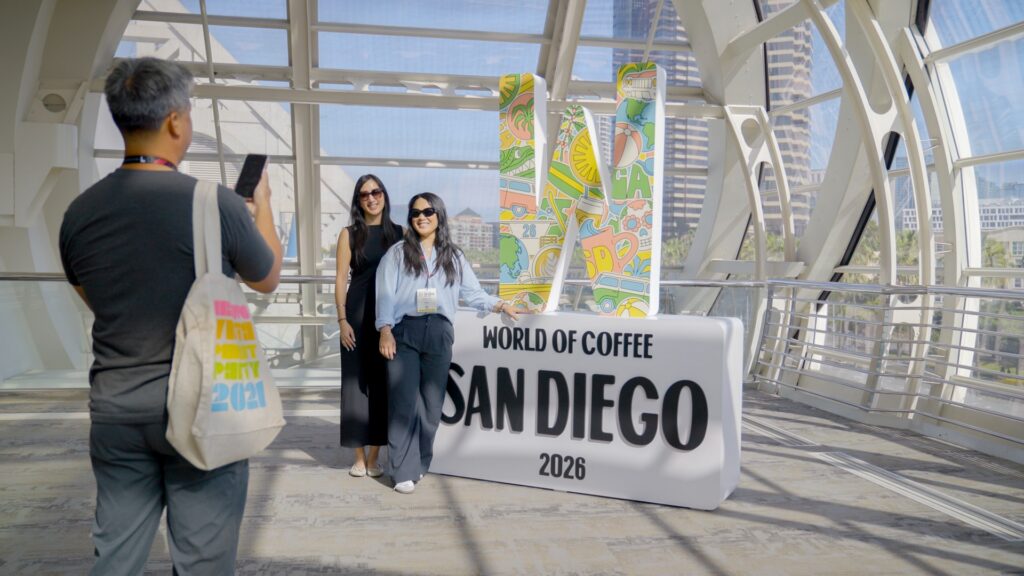
As it happens, if your mother ship beamed you into San Diego on April 10, 2026, then it’s your lucky day. On a giant billboard, right outside the City’s Convention Center, you see the words: Welcome to the World of Coffee, the Specialty Coffee Association Tradeshow.
Surely, they must know something about coffee, right?
The Big Daddy of them All
There are literally hundreds of coffee trade shows all over the world put on every year. But there is nothing quite like the Specialty Coffee Association’s World of Coffee. It is the big kahuna.
And if you’re walking into that show from another planet, you would, I am sure, find it all very impressive. The place just screams MONEY! And there are so very many people, packed in shoulder to shoulder, milling about everywhere.
All kinds of people. Young people with eager faces wearing barista aprons and free tote bags stuffed with giveaways. Lots of self-important looking bros with tattoos and man-buns. Gray faced executives flashing their perma-smiles in fancy suits.
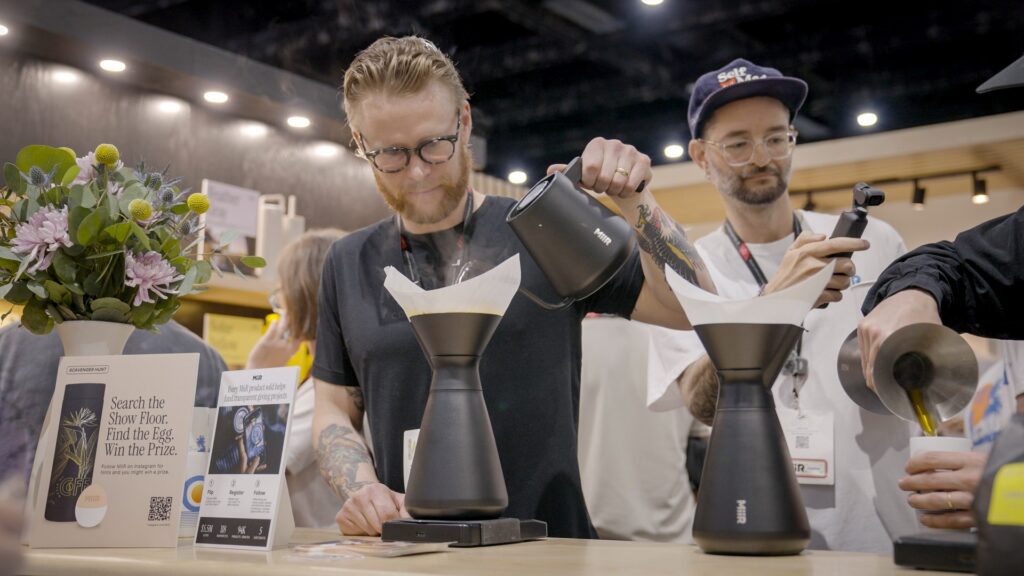
The show floor itself is gigantic and overwhelming. Seemingly the size of multiple football fields, with very well designed and expensive looking booths packed down dozens of rows.
There’s everything you could possibly imagine might have something to do with coffee. Like huge commercial roasters. Brewing equipment. Grinders. Water purification systems so you can get the cleanest brew.
There is a plethora of baked goods you could serve in your coffee shop. With or without an oven. And juice concentrates. And syrups. All kinds of sugars.
And menu boards. And packaging. And cups. And floor mats.
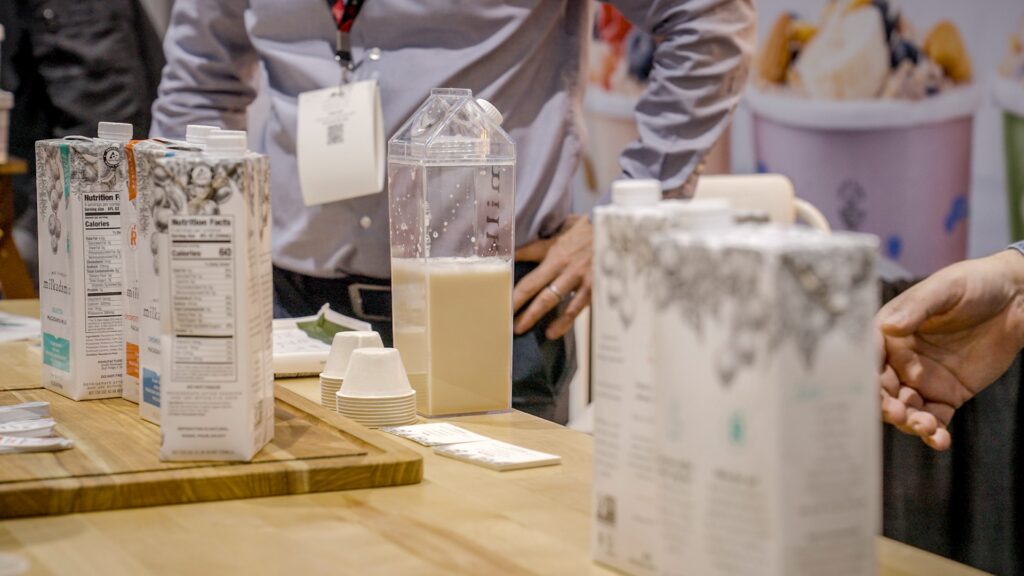
And don’t even get me started on alternative milk options. If you spend enough time hanging around that section of the show, it is entirely possible that you will come away thinking that pistachio milk is going to save the coffee industry. It’s not clear what it will save it FROM. But it must be important.
The Coffee Business
This is what coffee looks like on the consuming side of the value chain. And if you were our friend, the extraterrestrial, wandering into the World of Coffee tradeshow, who could blame you for thinking that the coffee business is booming.
According to the National Coffee Association’s website, US consumers spend nearly $301 million on coffee and related goods every day. That’s $110 billion a year. With a population of 342 million, that comes to around $322 per year for every man, woman, and newborn baby in America. Factor in wages, equipment spending, transportation, and the like, and the total economic impact of the coffee industry in the United States in 2022 was $343.2 billion, up 52.4% since 2015.
No wonder the tradeshow floor at World of Coffee screams money. There is a lot of it to be made, and everybody is there trying to get their piece of the pie.
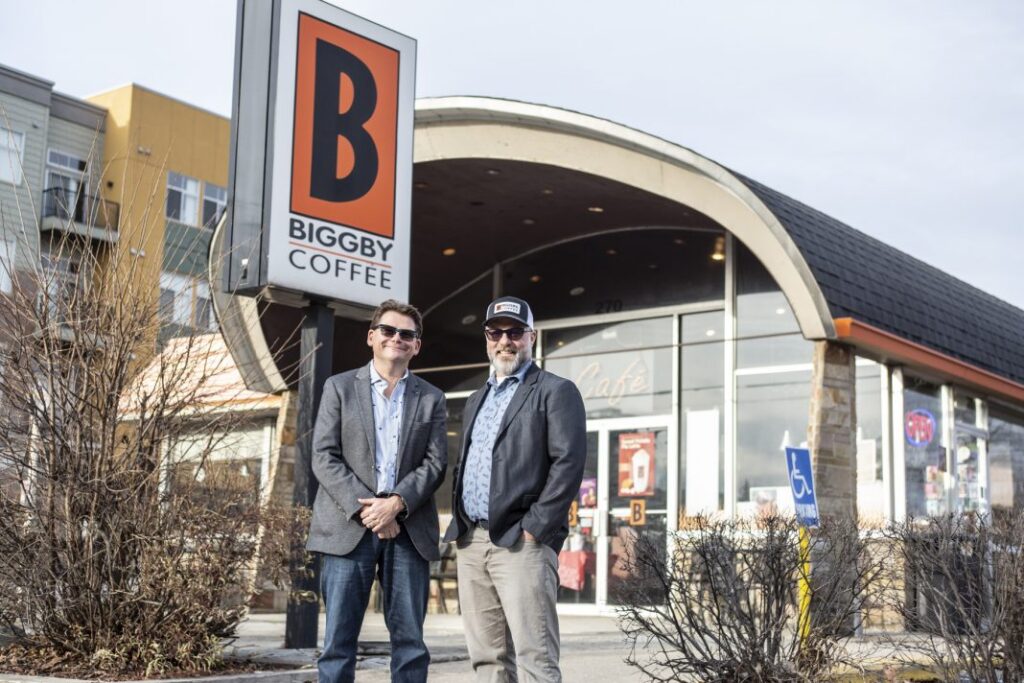
My husband, Bob, and his partner, Mike McFall, have been in the coffee business since 1995. And they, too, have done very well on this side of the value chain.
I have attended a lot of these big trade shows with Bob over the years. And I used to really enjoy them, like I’m guessing our extraterrestrial might. I found all the gadgets and whizzbang hoopla exciting and diverting. And I always came home with my free tote bag full of goodies, feeling great about the future of coffee.
But then in 2018 I started going to coffee producing countries, and meeting coffee farmers and their families. And everything changed.
Coffee is in Trouble
There is an irony behind the reason that Bob and I first started going to origin. In 2018, the SCA commissioned a white paper with the very non-sexy title: “Price Crisis Response Initiative.” In a better and fairer world, it might have changed everything.
The paper was intended to be a wake-up call for what was, and is, wrong with the coffee industry. Its main takeaway is as true today as it was in 2018: Coffee, and most specifically coffee farmers, are in trouble.
Why? The first, and most fundamental cause is the way coffee is bought and sold. Coffee is a commodity, traded on a global exchange. For a variety of reasons, coffee prices have been suppressed over the last several decades, to that point that producers have been paid less than their cost of production about 80% of the time. That has been devastating to families, the communities they live in, and the environment.
The flip side is that it has also fueled massive growth and profits in consuming countries. Cheap coffee makes the global north go round. And it has made a lot of people, including us, a great deal of money.
Meanwhile, climate change just ups the ante for producers that are already under severe stress because of pricing. It’s harder to farm in a world where you can no longer depend on the seasons. Too much heat, too much frost, too much rain, not enough rain, and rain at the wrong time are becoming the norm, with devastating consequences for the crop. And therefore, the farmer.
Pests and diseases are both more plentiful, and harder to manage, as they take advantage of weakened coffee trees, denuded soil, and the adverse climate.
The consequence, as the SCA white paper so eloquently pointed out, is that more and more coffee producers all around the world are abandoning their land and migrating to the global north for better opportunities.
The SCA’s conclusion was that the supply of coffee – the very thing that this massive global industry needs to exist – was, and is, under threat. That is the definition of an existential crisis.
Crickets
The paper was published to a resounding thud. Even today, even among the many people we know in this industry, very few know that it exists, let alone have read it.
Since its publication, we’ve been to more than 200 coffee farms in 17 coffee-producing countries. We have seen, firsthand, the devastation that our industry’s way of buying coffee is having on people, the planet, and communities.
The coffee industry and the way it functions in the world is unquestionably responsible for keeping people trapped in devastating poverty. That’s what inspired us to start OBIIS and change the way we buy our coffee in the first place. Once you know a thing, you can’t unknow it.
So, it’s hard to walk that shiny tradeshow floor, now, with all its bells and whistles, and not feel queasy. Because we know what’s happening on the other side of the value chain. Worse yet, thanks to their white paper, I know that the SCA knows it, too. But most of the people walking and working that tradeshow floor have no idea.
How can that be?
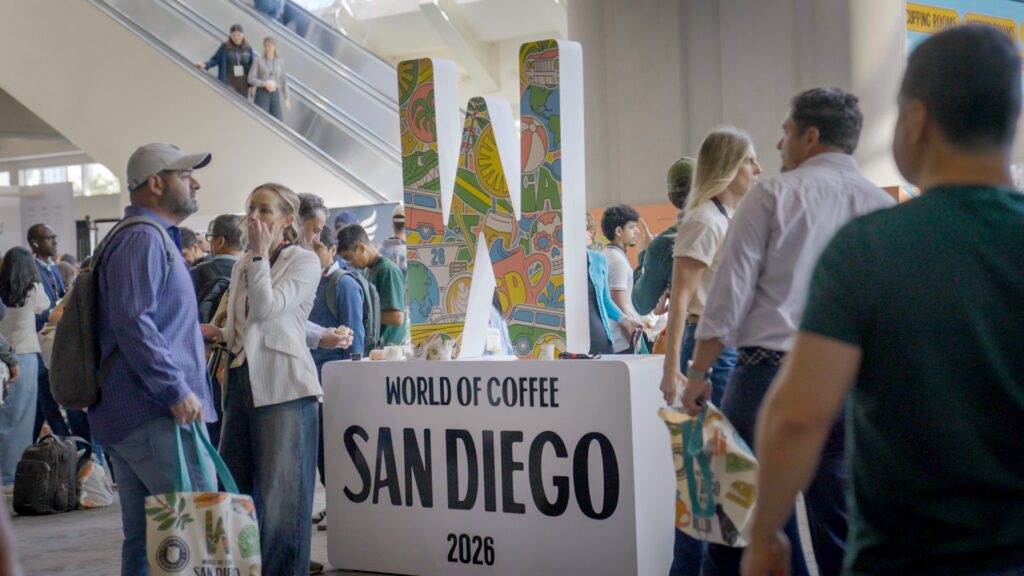
This year’s WORLD OF COFFEE
Walking into this year’s show, the first thing I saw was a giant electronic billboard. Mostly, it flashed a variety of ads for booths, and that kind of thing. But they also had a short, maybe 30-second piece, with the headline “coffee is fragile.” And reminding us that the future of coffee is, and I quote, “in our hands.”
It’s hardly an adequate description of the three-alarm fire that’s been raging for coffee producers around the world for the last several decades, as described in their own white paper. But it’s a start.
To support that, they had an educational track at the show, with all kinds of lectures on all kinds of issues and challenges in the industry. Some of them had to do with systemic inequity of the current pricing model, the challenges of climate change, and the need for wider adoption of regenerative agriculture.
Bob attended several of these. In every case, the presenters were earnest and knowledgeable. Everybody that Bob saw on those stages understood that coffee and coffee producers are in trouble and cared passionately about working on solutions.
The problem is that at a tradeshow with thousands of people in attendance — the very people that need to hear this message — there were only about 20 in the audience. And they were, more or less, the same 20 people at every one of those COFFEE IS FRAGILE, THE FUTURE IS IN OUR HANDS kinds of lectures.
As the industry’s preeminent trade association, the SCA has a big platform, and a big megaphone to articulate a case for change. But, in the years since that white paper came out, they have barely eked out a whisper.
If you’re paying close attention, you might notice that they are saying that COFFEE IS FRAGILE, and that they have lectures about it on the schedule. Even at that, though, the language they use is pretty milk-toast. “Coffee is fragile” doesn’t sound that scary. You could argue that it’s not meant to. It might be bad for business if people in the industry started to panic and question everything.
Either way, the fact is most people aren’t paying attention. And the SCA isn’t trying that hard to get them too.
Whose Trade Association is it?
There is so much money in the coffee business. We can talk about the industry as one sees it represented on the tradeshow floor. Cafes, roasters and equipment makers. And that’s impressive. But there is much more to it than that.
Huge, multi-national corporations, venerable trading houses that have been in coffee since it became a business centuries ago. Agrochemical companies, shipping and logistics companies, the big coffee houses like Nestle and Illy. For as much money as the rest of us in the industry might be making, that’s where the real money is.
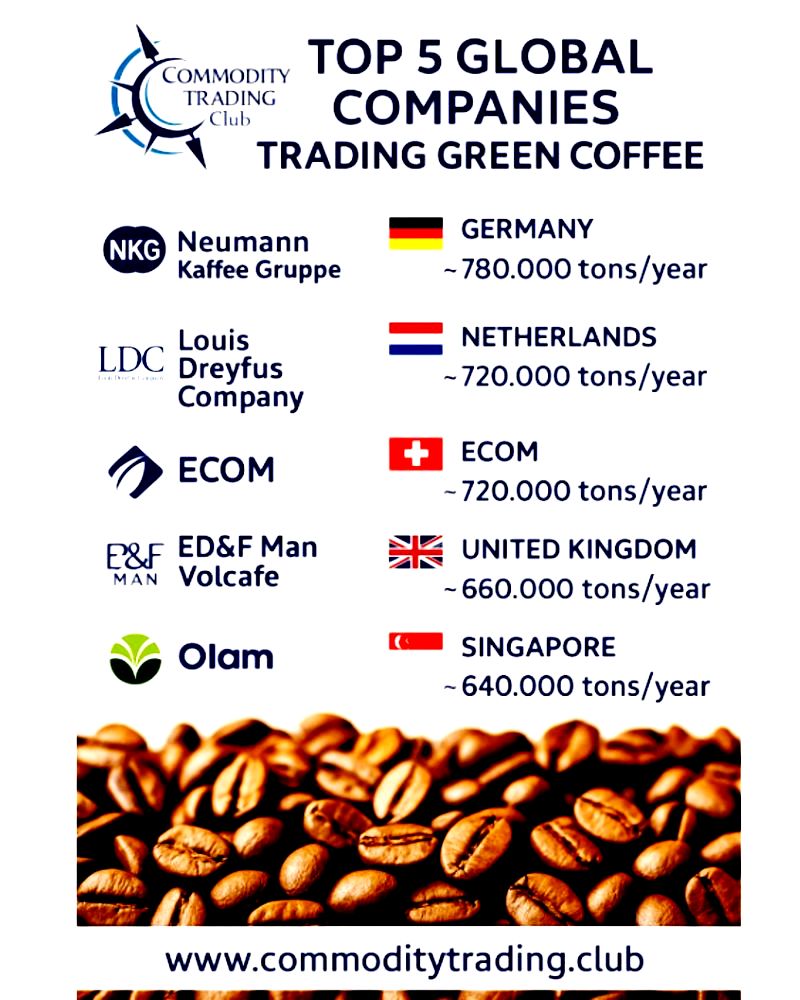
The SCA is their trade association, too. And they have made, and maintained, fortunes based on the status quo.
So, What is the Status Quo?
It’s easy to forget when you’re walking the SCA tradeshow floor that the coffee industry was born in colonialism and built on extraction and inequity. But that’s the distant past, right? The governments of England, France, Spain, Italy, Portugal, and the Netherlands are no longer administrating a colonial network of nations. So surely, one could conclude that kind of colonialism doesn’t exist anymore.
Except that when the colonizers and their standing armies left, the system itself didn’t change. Just the players. Colonialism was merely the umbrella under which the current infrastructure of global trade was forged: extraction from the global south to benefit the global north. That continues on virtually unchanged, as it always has. And it has made a lot of companies, and the executives that run them, very rich.
It comes at a huge cost for the people on the other side of the value chain: crushing, systemic poverty, environmental degradation, the disintegration of communities, and mass migration.
But hey, no worries, right? We’re at the SCA World of Coffee, and everything is bright and shiny! Pass me some pistachio milk, will ya?
The Black Curtain
Cognitive dissonance is defined as the psychological stress experienced when a person simultaneously holds two or more contradictory beliefs, ideas, or values. I can tell you, first-hand, that it can make you very queasy, kind of like vertigo.
To experience cognitive dissonance at the World of Coffee tradeshow, you have to know what’s happening at origin. And most people there have only the most superficial understanding of what it’s like to be a coffee farmer and what’s happening in coffee-growing communities.
That’s not by accident. Even the SCA’s own 30-second video about coffee being fragile features stunning vistas and plentiful coffee cherries in overflowing baskets. At a minimum, they could have chosen imagery that depicts the ravages of climate change… deforestation, diseased coffee, dried up rivers, forest fires. I mean, coffee really is fragile.
But they didn’t.
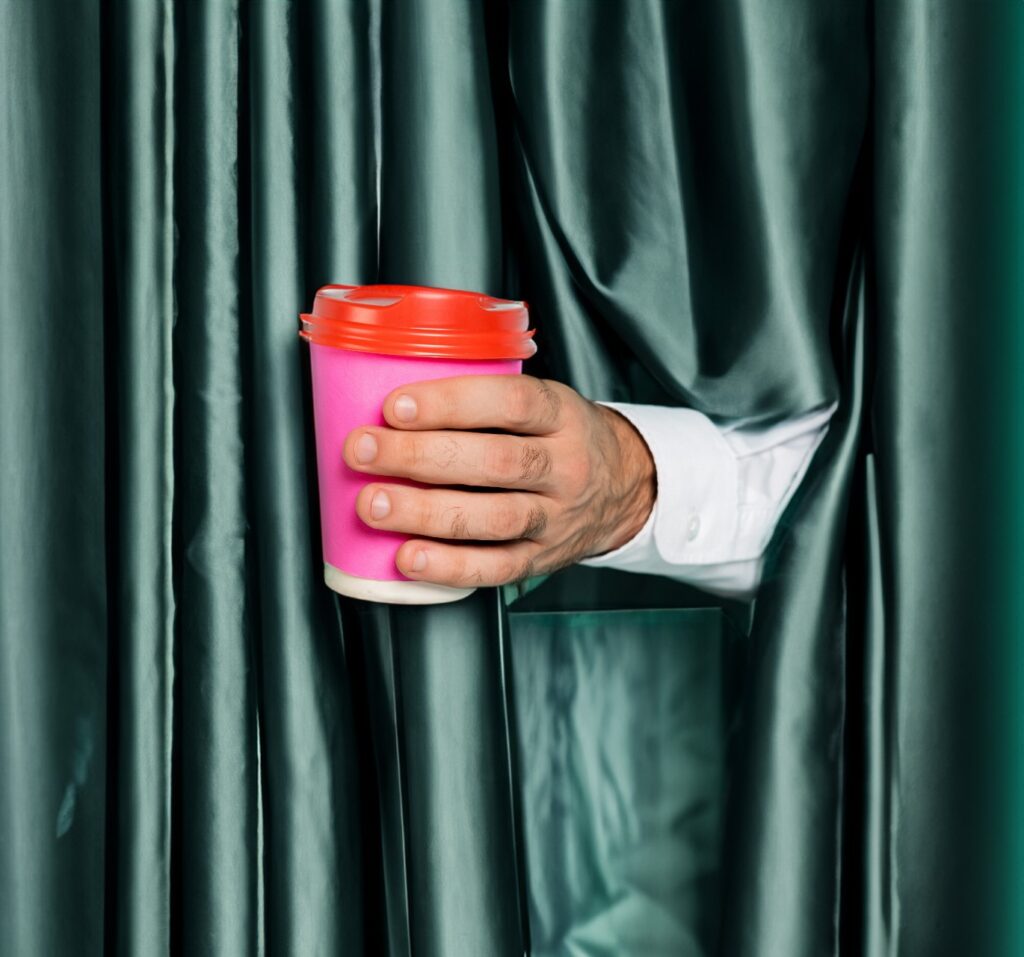
This is a symptom of something that Bob and I call the Black Curtain of Coffee. It’s this impenetrable veil between consuming countries like us, and what’s actually happening where it’s grown.
The curtain is the broker system, and all the machinations that coffee goes through to get from the farm to our shores. The curtain is the iconography the industry uses to promote itself: smiling coffee farmers, beautiful environs, bright red cherries overflowing in baskets, latte art. The curtain is the SCA World of Coffee tradeshow, where everybody is making lots of money, and pistachio milk seems oh so important.
The purpose of the curtain, and why so much time and energy is invested into keeping intact, is so that those of us on this side of the value chain stay fat and happy. Particularly, and most importantly, it’s designed to keep consumers happy. After all, who wants to confront the fact that their morning cup of coffee is likely full of the tears of children? It would be very bad for business.
Location, Location, Location
It’s worth noting that in its entire history, the SCA has never once held its big kahuna tradeshow in a producing country. If that doesn’t scream “pay no attention to what’s happening behind the curtain,” I don’t know what does.
They are changing that in 2026. This October, Panama will play host to the World of Coffee. I guess it’s a start. But Panama hardly qualifies as the “poster child” for what’s happening at origin.
For one thing, they don’t contribute much coffee to the world’s supply. They are only 35th, in terms of volume, on the list of producing countries. Their economy is relatively robust and diverse, and the health of their GDP is not reliant on coffee exports. That’s not true in most other coffee-producing countries.
They are known for growing very high-quality, high-priced coffee. And are particularly known for their Geisha, a variety of coffee that is extremely fussy and hard to produce.
There has been plenty of criticism of the SCA over the years for its focus on the consuming side of the value chain. It has been called elitist, prioritizing high-scoring coffee over equitable trade, and completely ignoring the negative repercussions of the industry in producing countries.
I don’t know whether this move to host World of Coffee at origin is intended to address those concerns or not. But if it is, much like their COFFEE IS FRAGILE campaign, it is lip service, at best. A way to look like they’re doing something about a problem, without actually doing anything.
If you listen carefully, you might just hear the strains of Nero’s apocryphal violin, while outside, Rome burns.
So, Why Go?
It’s a reasonable question. After all, I have just laid out a pretty compelling case that the SCA and the World of Coffee is emblematic of everything that is wrong with the industry.
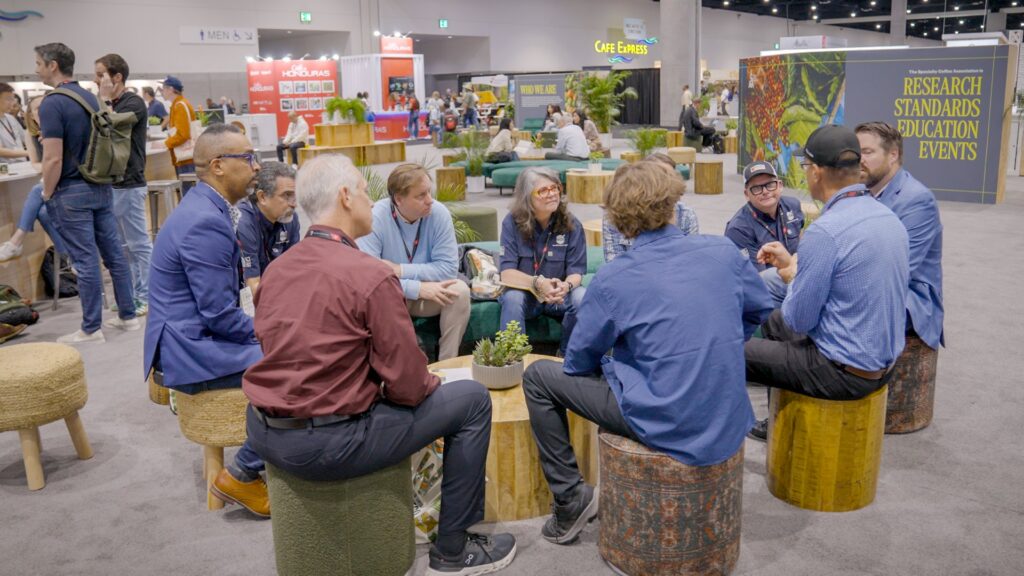
We go because everybody goes. And most importantly, people that we know, and for whom we have deep respect, are all there. There is a tribe of people in the industry who fully understand the problems and are doing amazing work to shift the needle on producer equity. It isn’t all just doom and gloom.
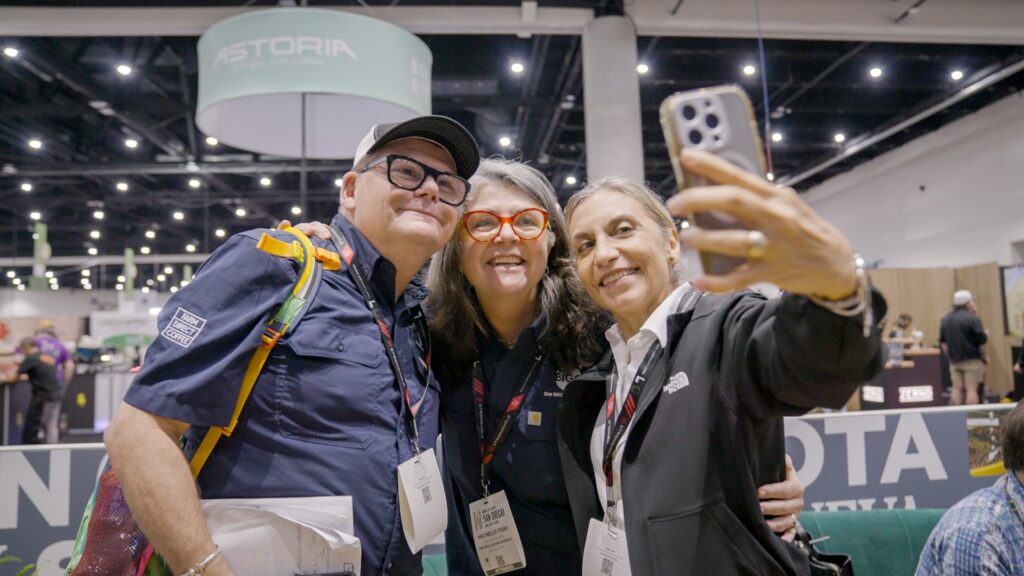
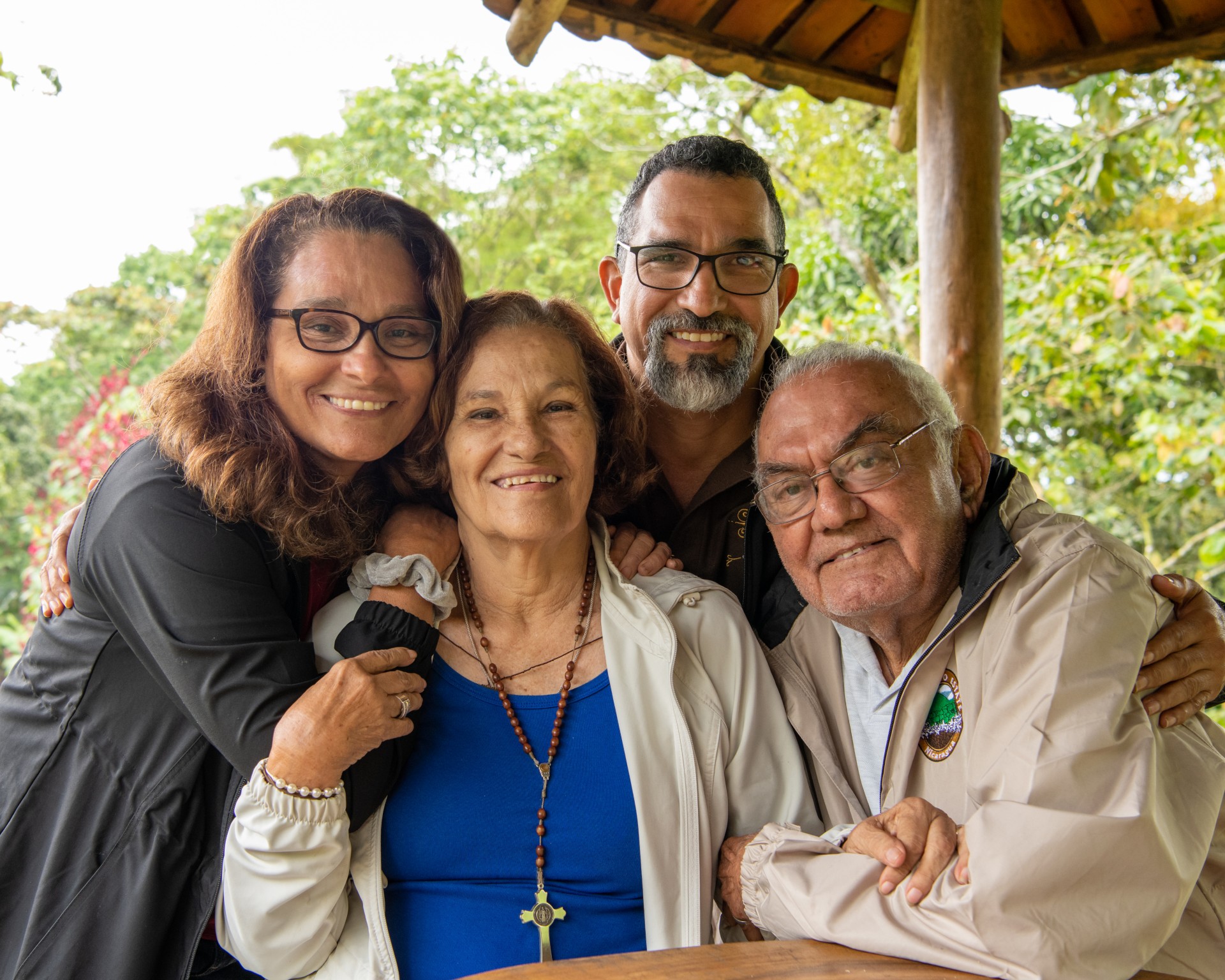
This year, we got to spend some time with Maria Esther Saut from our Farm-Direct Partner Finca la Fortaleza at the World of Coffee in San Diego.
And so, once a year, we have chance to hold meetings and have conversations with people that we consider allies in our goal of changing the industry. This year, we met with a slew of people, including our friends and partners at Onyx Coffee from Guatemala. We were introduced to an amazing coffee co-op focusing on regenerative agriculture in Brazil. We had breakfast with our old friend and travelling companion, Brendon Maxwell from Utopian Coffee in Fort Wayne. We had a fascinating conversation with a woman from FairTrade International. We spent time with our partners from Caravela Coffee in Colombia. And so much more. We always learn something new, and something interesting.
You could argue that in spite of themselves, and their focus on all things bright and shiny, the SCA has provided a vehicle through the World of Coffee for people who are trying to change the industry to come together. And that’s not nothing.
Beam Me Up, Scotty
So, how do you think our extraterrestrial friend is doing after three days of the World of Coffee in San Diego? From firsthand experience, I can tell you that our alien is exhausted, over-caffeinated, wondering how they will get all of their free goodies back to the mothership, and ready for some fresh, non-convention center air.
They will be wondering how a convention that does such a good job of attracting this many people to one place could be simultaneously so bad at making access available to food you can buy throughout the day. It’s hard to fuel yourself just on the samples you can glean from the baked-goods booths. And, they will be incredulous that SO MANY BATHROOMS could be out of order at the same time.
But they will come away with a love of coffee. And they will love the energy and the passion of the coffee crowd. We might even forgive them for thinking that pistachio milk could save the world.